You’re Earning More Than Your Parents Did. So Why Does It Feel Like Less?
Written by Natalie Goretski, 18 June 2026
Baby Boomers: needed $99,900/year to feel financially successful.
Gen Z: needs $587,800/year.
Same question. Six times the answer.
(These figures come from a US survey by financial firm Empower — but the generational gap they reveal is anything but uniquely American, as the Australian data below shows.)
That’s not Gen Z being dramatic. That’s Gen Z doing the math on the world they actually live in — and arriving at a very different number than the generation that shaped most of the financial advice still being handed out today.
The advice was written for a different economy
Here’s the standard financial playbook most of us inherited:
- Save 10% of your income
- Buy a home by 30
- Contribute to super and trust the compound interest
Solid advice — if you bought property when it cost 3–4x the average annual salary.
Today? In Sydney and Melbourne, that ratio sits closer to 12–14x. The playbook didn’t change. The economy did.
A 2025 peer-reviewed paper by Judith Nwoke at Thomas Jefferson University found that traditional financial planning models, built for Baby Boomers and Gen X, consistently fail to account for the economic realities now shaping how Millennials and Gen Z build (or struggle to build) wealth.
This isn’t a hot take. It’s an academic conclusion.
The literacy gap nobody talks about
Here’s a stat that stops most people cold:
Fewer than 30% of Millennials can correctly answer basic questions about interest rates, inflation, and investment risk.
That’s the most educated generation in history. More university degrees per capita than any cohort before them. And fewer than 1 in 3 can explain how inflation quietly eats their savings.
It’s not a intelligence problem. It’s a curriculum problem. School taught us how to earn money. Nobody taught us how money actually behaves once we have it.
So we default to the shortcut: income = wealth.
High salary → doing fine. Right?
Not exactly.
Income vs. wealth: the number that changes everything
Real wages — adjusted for inflation — have not kept pace with productivity since the early 2000s.
What that means in plain terms: your salary buys less of the things that actually build wealth (property, assets, long-term investments) than the same salary did 20 years ago. You can be earning six figures and quietly losing ground.
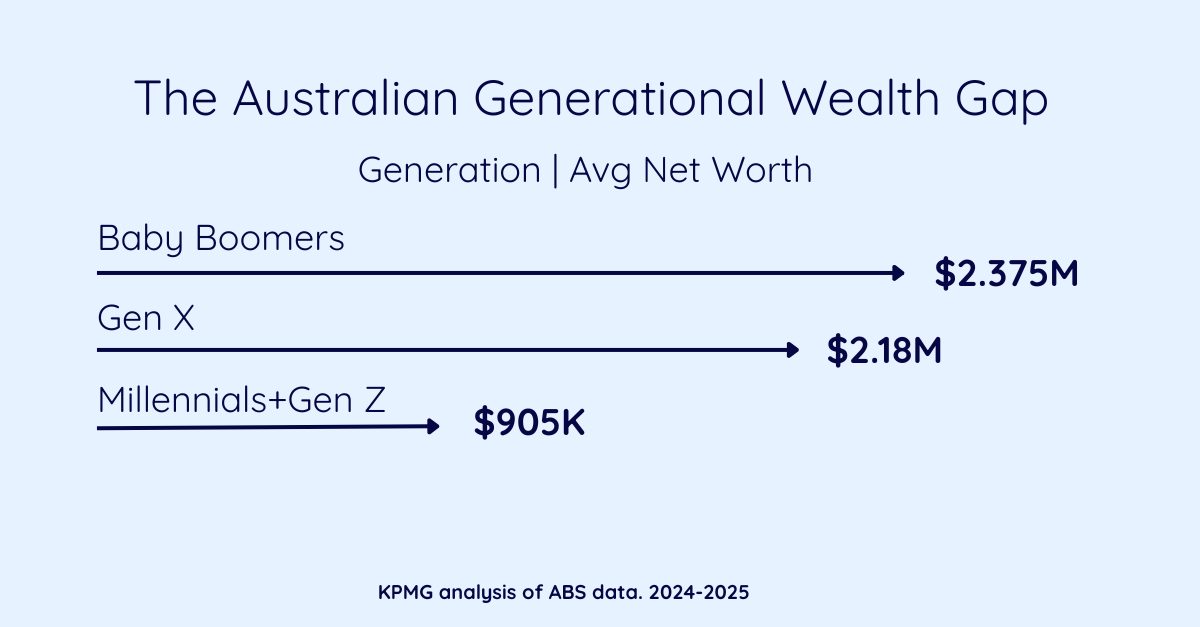
The proof is in who holds what. According to KPMG’s 2024–25 analysis of ABS data, the average Australian Baby Boomer household has a net worth of $2.375 million. Gen X sits just behind at $2.18 million. Millennials? $905,000 — less than half.
And that gap looks even worse when you factor in debt. Millennials carry gross debt equal to 54% of their net worth. For Baby Boomers, that figure is just 4%.
That gap isn’t about effort. It’s about timing, structural access, and — critically — whether you have a way to measure your actual financial position, not just your salary.
Two crashes in 15 years will do that to a generation
Millennials graduated into the 2008 financial crisis. Jobs evaporated. Property became unreachable.
Gen Z entered adulthood during a global pandemic, mass layoffs, and the worst inflation spike in 40 years — all before age 25.
Nwoke’s research points to this directly: economic disruptions, housing unaffordability, student debt, and shifting labour dynamics have created a structural disadvantage that older generations simply didn’t face at the same life stage.
The rational response? Skepticism about long-term planning. Why commit to a 30-year mortgage when the rules keep changing? Why trust a retirement projection from an industry that missed the last two crashes?
That skepticism makes sense. But it has a cost: high earners end up navigating by instinct in a game that rewards structure.
$3.5 trillion is about to change hands — right here in Australia
Over the next 20 years, Australia’s over-60s are expected to transfer an estimated $3.5 trillion in wealth to younger generations.
The largest intergenerational wealth transfer in Australian history.
Here’s the uncomfortable part: most of the people receiving it have no framework for managing it.
Not because they’re careless. Because the same financial literacy gap that made wealth-building hard also makes wealth-receiving complicated. Inherited or transferred wealth without a system gets absorbed — by lifestyle inflation, by poor investment decisions, by tax inefficiency, by simply not knowing what to do with a lump sum.
Receiving wealth is not the same as building it. And it’s not the same as keeping it.
So what does “financially successful” actually mean?
Back to those numbers:
Boomers say: $99,900/year
Gen Z says: $587,800/year
Reality: neither figure is the right question
Financial success isn’t a salary number. It’s a position — a real-time relationship between your income, your assets, your liabilities, and the rate at which inflation is working against all three.
Most high earners can tell you what they earn. Very few can tell you whether their net position improved or declined last year in real terms.
That’s the gap. Not income. Not effort. Not ambition.
A system for measuring where you actually stand.
One question before you close this tab
Right now, without checking any app or spreadsheet — could you answer this:
Is your wealth growing or shrinking in real terms?
Not your salary. Not your savings balance. Your actual purchasing power position, after inflation, after tax, after the cost of the life you’re building.
If the honest answer is “I don’t really know” — you’re not failing.
You’re just working with a map that was drawn for someone else’s journey.
The question is what you do with that.
Subscribe to my newsletter for practical financial insights written for the generations the old rulebook forgot.
Natalie Goretski is the founder of iViser Academy, an online financial education platform helping high-income professionals build structured, AI-powered financial systems.
Sources:
Nwoke, J.U.C. (2025). Bridging Generational Wealth Gaps: Financial Planning Innovations for Millennials and Gen Z Clients. International Journal of Research Publication and Reviews, Vol 6, Issue 4, pp. 5904–5917.
KPMG analysis of ABS National Accounts and Household Income and Wealth Survey, 2024–25.
Commonwealth Bank / Bernard Salt, Intergenerational Wealth Transfer Report, November 2025.
Additional data: Axios Modern Wealth Survey; Federal Reserve Distributional Financial Accounts Q4 2025.
Disclaimer: The information provided in this article, “You’re Earning More Than Your Parents Did. So Why Does It Feel Like Less?”, is intended for educational and informational purposes only. It does not constitute financial advice, legal advice, or professional recommendations.
While every effort has been made to ensure the accuracy of the information at the time of publication, iViser Academy and the author make no guarantees of completeness, reliability, or applicability to your individual circumstances.
You should always consider your personal financial situation and, where necessary, seek independent advice from a licensed financial professional before making financial decisions. The author and iViser Academy accept no liability for any loss, damage, or consequences that may arise from reliance on the content of this guide. Use of this material implies acceptance of this disclaimer.
