The Copper Problem Isn't Scarcity. It's Supply.
Written by Natalie Goretski, 3 September 2026
As technology advances, the world needs more copper across a growing range of industries — and meeting that demand is becoming increasingly difficult. There is plenty of copper in the ground. The problem is getting enough of it into the economy.
In 2018, Stanislaw Pietrzyk and Barbara Tora examined a deceptively simple question: Can the world run short of copper?
At the time, global copper reserves were estimated at around 720 million tonnes, with another 5.6 billion tonnes classified as identified or undiscovered resources.
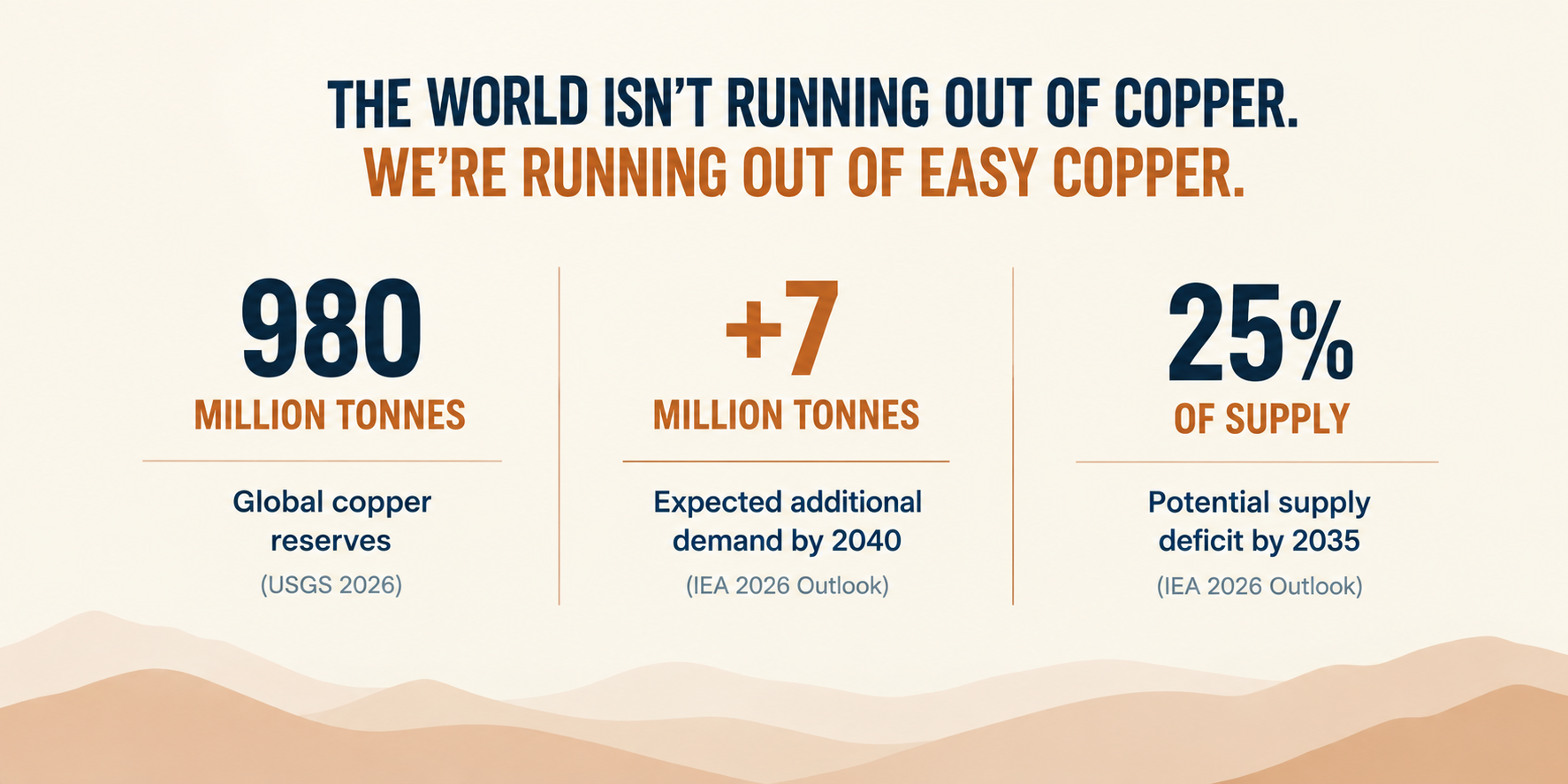
The latest US Geological Survey data estimates global copper reserves at around 980 million tonnes, while 2025 mine production reached approximately 23 million tonnes.
So why is copper increasingly described as a critical mineral?
Because having copper in the ground isn't the same as having copper available to the economy.
The problem isn't scarcity. It's supply.
A geological resource is not necessarily an economically recoverable reserve. A deposit may exist but be too expensive, technically difficult, environmentally challenging or politically risky to develop.
S&P Global's analysis of 214 copper mines found that a new mine takes an average of about 17 years from discovery to first production. That timeline has increased from 12.7 years for mines that started production in 2005–09 to 17.9 years for those starting in 2020–23. More than 12 years of that timeline is consumed by exploration, feasibility studies, environmental assessments, permitting and legal or administrative processes. Construction itself accounts for only about 2.3 years.
Electricity grids, renewable generation, electric vehicles, industrial electrification and data centres all require copper. The International Energy Agency (IEA) estimates that copper demand will increase by around 7 million tonnes by 2040 — the largest absolute increase among the minerals it tracks.
The challenge is that new supply is not keeping pace with this growing demand. Based on the current project pipeline, the IEA projects a potential 25% copper supply deficit by 2035. The estimate has improved from around 30% in its previous outlook as new projects advance. But a quarter of required supply is still a substantial gap.
We're not the first civilisation to face this problem
There is an intriguing parallel with the Bronze Age.
Around 3,000 years ago, bronze-producing societies depended on copper and tin. Copper was relatively widespread, but tin was much scarcer, creating a strong incentive for long-distance trade.
Recent archaeological research, published in the journal Antiquity, has shown just how far those networks extended. Chemical and isotopic analysis found that tin ingots recovered from Mediterranean shipwrecks dating to around 1300 BC can be traced to tin ores in south-west Britain — roughly 4,000 kilometres away.
This does not prove that a tin shortage caused the Bronze Age collapse. The collapse was complex, with evidence pointing to warfare, climate change, political instability and disruption of trade networks.
But it illustrates a broader principle: a civilisation can become vulnerable not because a resource disappears, but because its supply chain becomes unreliable.
The subsequent spread of iron metallurgy offered an alternative. Iron was initially harder to smelt and work than bronze, but iron ore was far more geographically abundant.
Copper faces a similar problem today
The IEA is highlighting declining ore quality, increasingly difficult deposits and the enormous capital investment required to develop new mines.
Lower-grade ore means more rock must be mined and processed to produce the same amount of copper. More rock means more:
energy + water + processing capacity + infrastructure + capital.
Higher costs for extracting, processing and transporting copper can work their way through supply chains, eventually affecting the prices of products and services that use the metal — from electronics and communications infrastructure to electric vehicles.
That makes the supply challenge more than a problem for mining companies. It can eventually become a cost that businesses and consumers have to absorb.
So the bigger question is whether we can produce enough copper, economically and reliably, to support the infrastructure we are trying to build.
The Bronze Age offers a fascinating warning.
The solution wasn't simply finding more tin.
It was finding a different way to build.
Our copper challenge could lead us in a similar direction — greater material efficiency, technologies that use less copper, better recycling, substitution.
Sometimes the biggest constraint on a resource isn't how much is left in the ground. It's how much it costs to supply what the economy needs.
Subscribe to my Newsletter if you found this interesting, I dig into what’s actually changing in personal finance and retirement like this every issue.
Natalie Goretski is the founder of iViser Academy, an online financial education platform helping high-income professionals build structured, AI-powered financial systems.
Sources:
Pietrzyk, S. & Tora, B. (2018) — “Trends in global copper mining – a review”IOP Conference Series: Materials Science and Engineering, Vol. 427, 012002.DOI: 10.1088/1757-899X/427/1/012002. https://iopscience.iop.org/article/10.1088/1757-899X/427/1/012002
U.S. Geological Survey (USGS) — Mineral Commodity Summaries 2026: Copper, https://pubs.usgs.gov/publication/mcs2026
International Energy Agency (IEA) — Global Critical Minerals Outlook 2026Published 16 July 2026.https://www.iea.org/reports/global-critical-minerals-outlook-2026
S&P Global — “Copper in the Age of AI: Challenges of Electrification” (2026) https://www.spglobal.com/en/research-insights/special-reports/copper-in-the-age-of-ai
S&P Global — “New major copper discoveries sparse amid shift away from early-stage exploration” https://www.spglobal.com/market-intelligence/en/news-insights/research/new-major-copper-discoveries-sparse-amid-shift-away-from-early-stage-exploration
Roberts et al. (2025) — “From Land's End to the Levant: did Britain's tin sources transform the Bronze Age in Europe and the Mediterranean?”Antiquity, Vol. 99, Issue 405. https://www.cambridge.org/core/journals/antiquity/article/from-lands-end-to-the-levant-did-britains-tin-sources-transform-the-bronze-age-in-europe-and-the-mediterranean/2330F3B6498B210DA61B89026A1F38EA
IEA — Recycling of Critical Minerals (2024) https://www.iea.org/reports/recycling-of-critical-minerals
Disclaimer: The information provided in this article, “The Copper Problem Isn't Scarcity. It's Supply.” is intended for educational and informational purposes only. It does not constitute financial advice, legal advice, or professional recommendations.
While every effort has been made to ensure the accuracy of the information at the time of publication, iViser Academy and the author make no guarantees of completeness, reliability, or applicability to your individual circumstances.
You should always consider your personal financial situation and, where necessary, seek independent advice from a licensed financial professional before making financial decisions. The author and iViser Academy accept no liability for any loss, damage, or consequences that may arise from reliance on the content of this guide. Use of this material implies acceptance of this disclaimer.