The Card Surcharge Is Gone. But Who Pays?
Written by Natalie Goretski, 15 October 2026
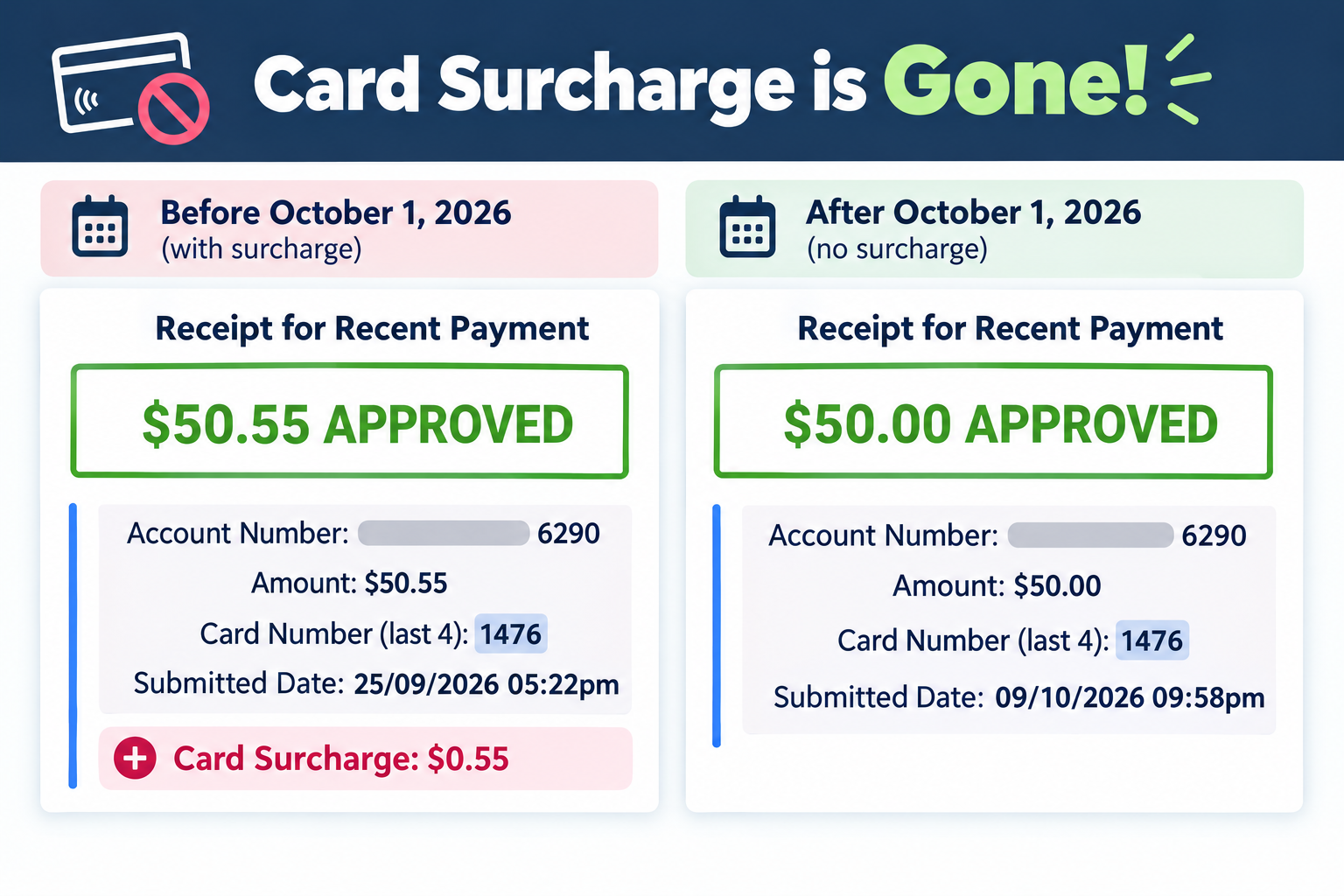
From 1 October 2026, Australians can no longer be charged a separate surcharge for paying by eftpos, Visa or Mastercard.
American Express is also removing surcharging from the same date, on a voluntary basis rather than as part of the RBA's formal ban — so in practice, surcharges are disappearing from nearly every card type Australians commonly use, not just the three networks directly covered by the RBA's rules. At first glance, that sounds simple. A $100 purchase costs $100, with no extra 1% or 1.5% added at the checkout.
But there is another part of the reform that raises a bigger question: If businesses can no longer charge customers separately for card payments, where does the cost of accepting those cards go?
The Cost Doesn't Disappear
Businesses pay fees whenever customers use cards. These fees cover the services and infrastructure needed to process payments. One component is the interchange fee. This is a fee paid by the merchant's bank to the bank that issued the customer's card.
From 1 October, the Reserve Bank of Australia (RBA) is lowering the maximum interchange fees permitted on domestic card transactions. The cap for consumer credit cards is falling from 0.8% to 0.3%. Debit and prepaid card caps are also being reduced. The aim is to lower merchant costs and improve competition.
Small businesses could benefit particularly because they often pay rates closer to the existing caps. However, interchange is only one part of the total merchant service fee. Businesses will still pay for payment processing, card network services and other related costs.
So Who Pays?
A business could absorb the remaining cost or incorporate it into its general pricing.
A customer who previously paid $100 plus a $1.50 surcharge might simply see a price of $101.50. The cost becomes less visible rather than necessarily disappearing. But the outcome will depend on the business. Some may absorb part of the cost, while others may adjust prices. Lower interchange fees could also reduce their expenses, so it would be wrong to assume every business will simply add its previous surcharge to its prices.
What About Banks and Rewards?
The consequences extend beyond businesses and customers. Banks that issue cards receive interchange revenue. Lower caps mean less income from eligible transactions, although the effect will vary across institutions and card portfolios. The RBA estimates these interchange reductions will cut what merchants pay banks and card issuers by roughly $660 million a year.
Its own assessment is notable: much of that revenue has effectively been subsidising card issuers' loyalty programs and other rewards, rather than reflecting the genuine cost of processing a transaction. That's a big part of why rewards programs are a likely pressure point, rather than a side effect. To respond, some banks could reduce credit-card rewards, increase annual fees or change other card benefits. These are possible responses, not inevitable outcomes for every cardholder.
There's also a wrinkle that cuts against the idea of a uniform saving for all merchants. Interchange caps on business and commercial credit cards aren't changing — they remain at 0.8%. The RBA is removing a separate pricing mechanism called the "weighted-average benchmark" that applied to these cards, and several industry analysts expect this could actually push average interchange costs on business-card transactions up, not down. So a merchant whose customers mostly pay with personal debit and credit cards should see costs fall. One whose customers pay mostly with business or corporate cards may not — and could even see a modest increase.
Banks and payment providers that process transactions for businesses face a different issue. They must continue to fund their payment infrastructure and services, and they may still charge merchants for those services even as interchange costs fall. The extent to which businesses benefit will depend partly on whether payment providers pass the savings through to their customers.
The RBA is also introducing greater fee transparency to help businesses compare payment providers and assess their costs. Monitoring how interchange reductions flow through to merchant service fees will help show whether the intended savings are reaching businesses.
A Change in How Costs Are Shared
The reform isn't simply a win for consumers and a loss for businesses. Merchants lose the ability to add a separate surcharge but may benefit from lower payment costs, unless their customers pay mostly with business cards. Customers avoid a visible fee, while some could face changes to general prices or credit-card rewards. The surcharge is disappearing. The cost of accepting cards isn't — it's just being redistributed, and not evenly.
The bigger question is how much of the intended savings will actually reach the people paying the bills.
Subscribe to my Newsletter for more insights into what's changing in the economy, financial markets and the world of money — and what it could mean for everyday life.
Natalie Goretski is the founder of iViser Academy, an online financial education platform helping high-income professionals build structured, AI-powered financial systems.
Sources:
Reserve Bank of Australia, "Review of Merchant Card Payment Costs and Surcharging - Phase 3: Impact and Implementation".
The Paypers, "RBA to ban card surcharging and reduce interchange fees from October 2026".
Australian Frequent Flyer, "Surcharging Banned, Lower Interchange Fees: The 2026 RBA Changes Explained"
Disclaimer: The information provided in this article, “The Card Surcharge Is Gone. But Who Pays?” is intended for educational and informational purposes only. It does not constitute financial advice, legal advice, or professional recommendations.
While every effort has been made to ensure the accuracy of the information at the time of publication, iViser Academy and the author make no guarantees of completeness, reliability, or applicability to your individual circumstances.
You should always consider your personal financial situation and, where necessary, seek independent advice from a licensed financial professional before making financial decisions. The author and iViser Academy accept no liability for any loss, damage, or consequences that may arise from reliance on the content of this guide. Use of this material implies acceptance of this disclaimer.