Retirement Isn’t an Age Anymore. It’s a Financial Decision.
Written by Natalie Goretski, 4 August 2026
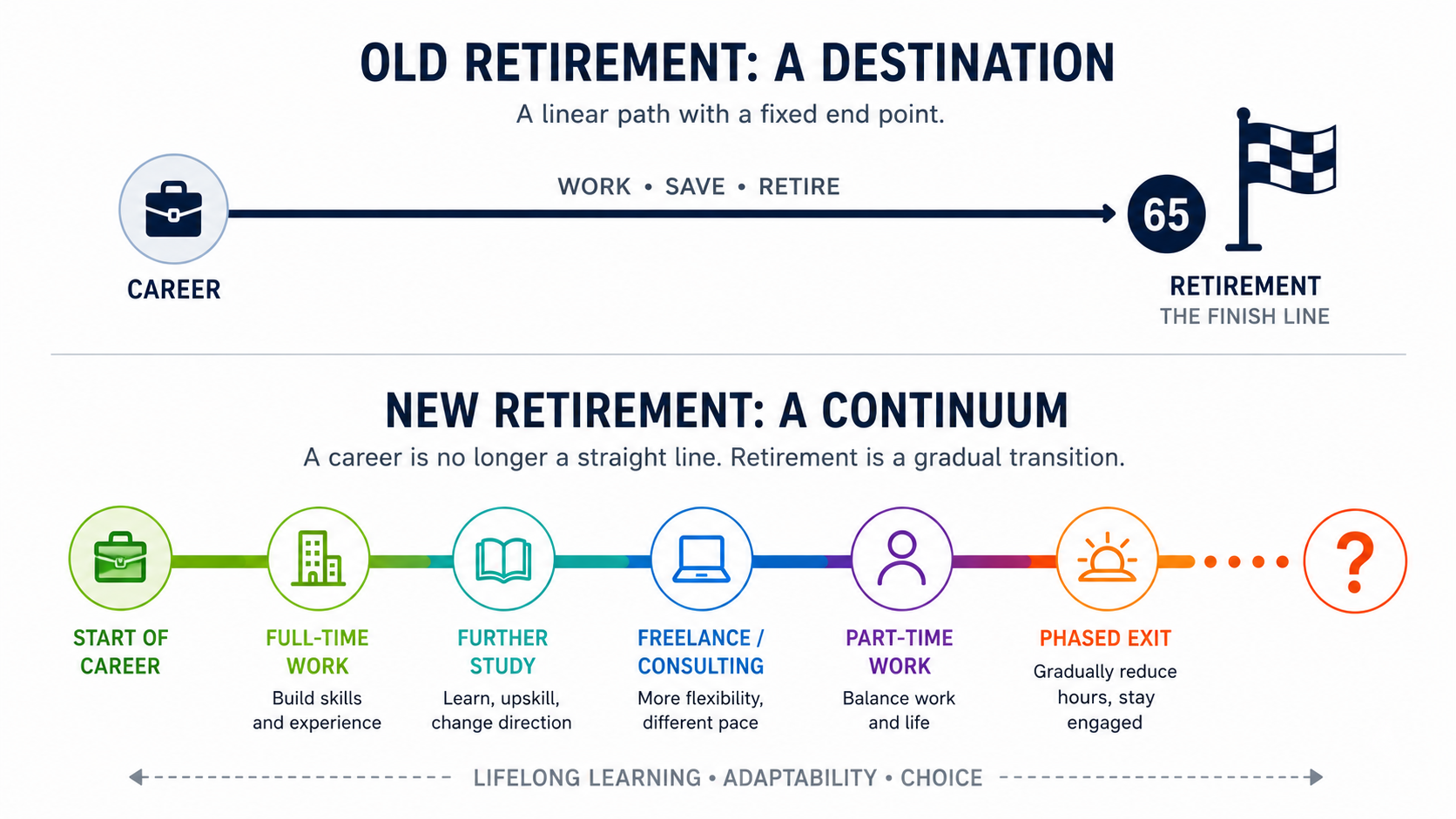
For much of the twentieth century, retirement was built around the expectation of one long career followed by one final transition out of work.
People entered the workforce, built a career with one or two employers, contributed to a pension or superannuation fund, and retired around the age of 65. Retirement marked a clear transition: work ended and a new stage of life began.
That model is becoming less representative of how younger Australians expect their careers to unfold.
Many will change employers more frequently, retrain throughout their working lives, and move between different forms of employment. Some may combine full-time work with consulting, freelance projects, or small businesses. Others may gradually reduce their hours rather than stop at a single point in time.
None of this suggests retirement has become less important, or that superannuation has lost its relevance. Interestingly, younger Australians appear to be paying closer attention to their retirement savings than previous generations — and the system itself may soon begin paying closer attention to them as well, from a much younger age than before.
The question, then, isn’t whether retirement still matters. It’s whether retirement itself is changing.
That distinction matters because the assumptions that shaped retirement planning for previous generations were built around careers that were generally more stable and predictable. Today’s workforce is likely to experience more career transitions and roles that don’t even exist yet.
A career is no longer a single, uninterrupted journey
The traditional career path was built around stability. Many people entered the workforce in their twenties, remained with one employer — or at least within the same profession — for decades, and retired after a long, continuous stretch of employment. Retirement planning reflected that relatively predictable pattern.
According to McCrindle Research, Millennials and Generation Z now make up the largest share of Australia’s workforce — there are now more employed Australians born since 1980 than those born before it. This generational shift matters because it’s these workers who are expected to change employers most often, retrain repeatedly, and move through more distinct occupations than any generation before them, often in roles that don’t yet exist.
Australia’s retirement patterns are shifting alongside this. According to the ABS, the average intended retirement age is now 65.6 years, continuing a gradual upward trend. At the same time, retirement is becoming less predictable: around 40% of Australians who intend to retire say they don’t know when they’ll actually do so. Rather than working towards a fixed retirement age, many are waiting until they feel financially secure enough to leave the workforce.
Younger Australians aren’t ignoring retirement — and the system is starting to meet them earlier
A common assumption is that younger generations are too focused on the present to think seriously about retirement. The evidence suggests otherwise. Research by McCrindle found that 54% of Generation Z Australians check their superannuation balance at least once a month, compared with 42% of Millennials, 33% of Generation X, 31% of Baby Boomers, and just 17% of the Builder generation. These findings suggest that younger Australians are engaging with their retirement savings earlier and more actively than previous generations.
That engagement may reflect the environment in which they entered the workforce. Many have experienced the Global Financial Crisis, the COVID-19 pandemic, high inflation, rising housing costs, and rapidly changing labour markets. At the same time, managing super has become easier than ever, with most funds offering mobile apps, real-time balances, and retirement calculators that make long-term savings far more visible than they were a decade ago.
There’s also a policy shift on the horizon that could reinforce this trend. Under current law, workers under 18 are only entitled to compulsory superannuation contributions if they work more than 30 hours a week, a threshold that excludes many teenagers working casual jobs.
In July 2026, delegates at the Australian Labor Party’s National Conference voted to include a commitment in the party’s National Platform to extend compulsory super to under-18 workers regardless of hours worked. Importantly, this is not yet law. No legislation has been introduced and no commencement date has been announced.
The proposal has been welcomed by the superannuation industry. Analysis by Rest suggests that removing the 30-hour threshold could increase a typical 15-year-old’s super balance by around $3,400 by age 18 and approximately $18,100 by retirement. If implemented, even teenagers working a single casual shift each week would begin accumulating super from their first pay cheque.
The system hasn’t fully caught up with the workforce it was designed to serve
While careers are becoming more flexible, Australia’s retirement system still largely assumes a traditional employment relationship: one employer, regular hours, and compulsory superannuation contributions attached to every payslip.
That assumption no longer reflects the reality for a growing share of the workforce.
Many gig and platform workers are classified as independent contractors rather than employees, meaning they generally fall outside the Superannuation Guarantee system. Unlike traditional employees, they may receive no compulsory employer contributions and miss out on the automatic compounding that superannuation is designed to provide.
Recent reforms have begun to address this gap. Since August 2024, “employee-like” gig workers have gained the ability to apply to the Fair Work Commission for minimum standards, including superannuation. However, these protections are not universal, and many workers with non-traditional employment arrangements remain outside the system.
This matters because the workforce itself is changing. If younger Australians are increasingly expected to move between permanent employment, contracting, self-employment, and platform work throughout their careers, retirement systems designed around continuous traditional employment may face growing pressure to evolve as well.
Retirement is shifting from a destination to a continuum
Taken together, the evidence points to a broader shift. Retirement isn’t becoming less important — it is becoming less defined as a single, fixed endpoint.
Earlier generations typically planned for retirement as the point at which work would end. Younger Australians are more likely to experience longer careers, multiple career transitions, periods of self-employment, and more flexible ways of working. In that context, retirement becomes less about reaching a finish line and more about navigating a career that is longer, less linear, and more adaptable.
Perhaps the most significant change isn’t that younger Australians value retirement differently. It’s that they’re preparing for a future in which work itself is evolving — and retirement may increasingly become a gradual transition rather than a single event.
If the nature of retirement is changing, what does it mean to be truly prepared for it?
Subscribe to my Newsletter if you found this interesting, I dig into what’s actually changing in personal finance and retirement like this every issue.
Natalie Goretski is the founder of iViser Academy, an online financial education platform helping high-income professionals build structured, AI-powered financial systems.
Sources:
Australian Bureau of Statistics (ABS). Retirement and Retirement Intentions, Australia. https://www.abs.gov.au/statistics/labour/employment-and-unemployment/retirement-and-retirement-intentions-australia/2024-25
McCrindle Research (2021). Australia Towards 2031: The demographic, consumer and behavioural trends shaping the nation. https://www.researchgate.net/profile/Mark-Mccrindle/publication/354533048_Australia_Towards_2031_The_demographic_consumer_and_behavioural_trends_shaping_the_nation/links/613d9ffbe4419c5e6ec6c659/Australia-Towards-2031-The-demographic-consumer-and-behavioural-trends-shaping-the-nation.pdf
Australian Labor Party (2026). National Platform (as amended at the 2026 National Conference).
Rest Super (2026). Media release / policy analysis. https://rest.com.au/why-rest/about-rest/news/welcome-alp-support-super-under-18s
Fair Work Ombudsman. (n.d.). Employee-like workers. https://www.fairwork.gov.au/find-help-for/independent-contractors/regulated-workers/employee-like-workers
Disclaimer: The information provided in this article, “Retirement Isn’t an Age Anymore. It’s a Financial Decision.”, is intended for educational and informational purposes only. It does not constitute financial advice, legal advice, or professional recommendations.
While every effort has been made to ensure the accuracy of the information at the time of publication, iViser Academy and the author make no guarantees of completeness, reliability, or applicability to your individual circumstances.
You should always consider your personal financial situation and, where necessary, seek independent advice from a licensed financial professional before making financial decisions. The author and iViser Academy accept no liability for any loss, damage, or consequences that may arise from reliance on the content of this guide. Use of this material implies acceptance of this disclaimer.