9.9 Years to Repay a Degree That Might Not Exist By Then
Written by Natalie Goretski, 14 July 2026
For decades, Australians have been told a university degree is one of the best financial investments they can make. But there’s a question prospective students should now be asking — one that simply didn’t exist for previous generations.
If you’re about to commit to a debt-funded degree, it’s no longer enough to ask “what does this profession pay today?” You also need to ask “how likely is this occupation to be reshaped by the time I graduate?” That second question is still largely missing from the conversation.
For a school leaver choosing a career today, that’s a genuinely new layer of financial due diligence. A university degree isn’t just an educational decision anymore — it’s a long-term investment backed by debt, and deserves to be assessed like one. Worth starting with the number almost everyone’s heard, before getting to the one almost nobody’s asking about yet.
Where the “$800,000 More” Number Came From
The claim traces back to Graduate Winners, a 2012 Grattan Institute report based on 2006 census data. Government budget papers later combined the male and female estimates into a single figure, giving rise to the familiar “million-dollar degree” headline.
The earnings premium is real. But the original report never suggested every graduate would earn an extra million dollars — it compared median outcomes across different groups, and individual results vary considerably. Grattan’s follow-up, Mapping Australian Higher Education, updated the estimate using 2011 census data, landing on an after-tax lifetime premium of roughly $900,000 for men and $700,000 for women — about $800,000 on average.
The same report found the advantage for younger graduates had already started narrowing: between 2006 and 2016, the income gap between bachelor’s graduates and Year 12 leavers aged 25–34 fell by around 8% for men and 6% for women. A degree still paid off — the flat, single-number “million-dollar degree” story was already less representative of reality, well before AI entered the picture.
Whose Degree, and in What Field?
Grattan’s 2019 Risks and Rewards report moved past the average and modelled expected lifetime earnings — after tax and course costs — by academic ability, field of study, and gender. A male humanities graduate is projected to earn roughly $300,000 less over a lifetime than a commerce graduate with the same academic ability. A commerce diploma is even projected to outperform a humanities bachelor’s degree by close to 30%.
Nursing and education produced the most consistent outcomes across academic entry scores. Humanities and science showed far greater variation — strong grades alone don’t guarantee a strong financial return. Choosing the right field, in other words, can move lifetime earnings more than choosing university over any other pathway does.
What the ABS Numbers Add
The ABS’s 2022–23 Survey of Qualifications and Work confirms the broader pattern: men working full-time with three or more post-school qualifications earned an average weekly income of $2,558 — around $983 more than men with no post-school qualification. For women, the figures were $2,131 versus $1,274, a difference of about $857.
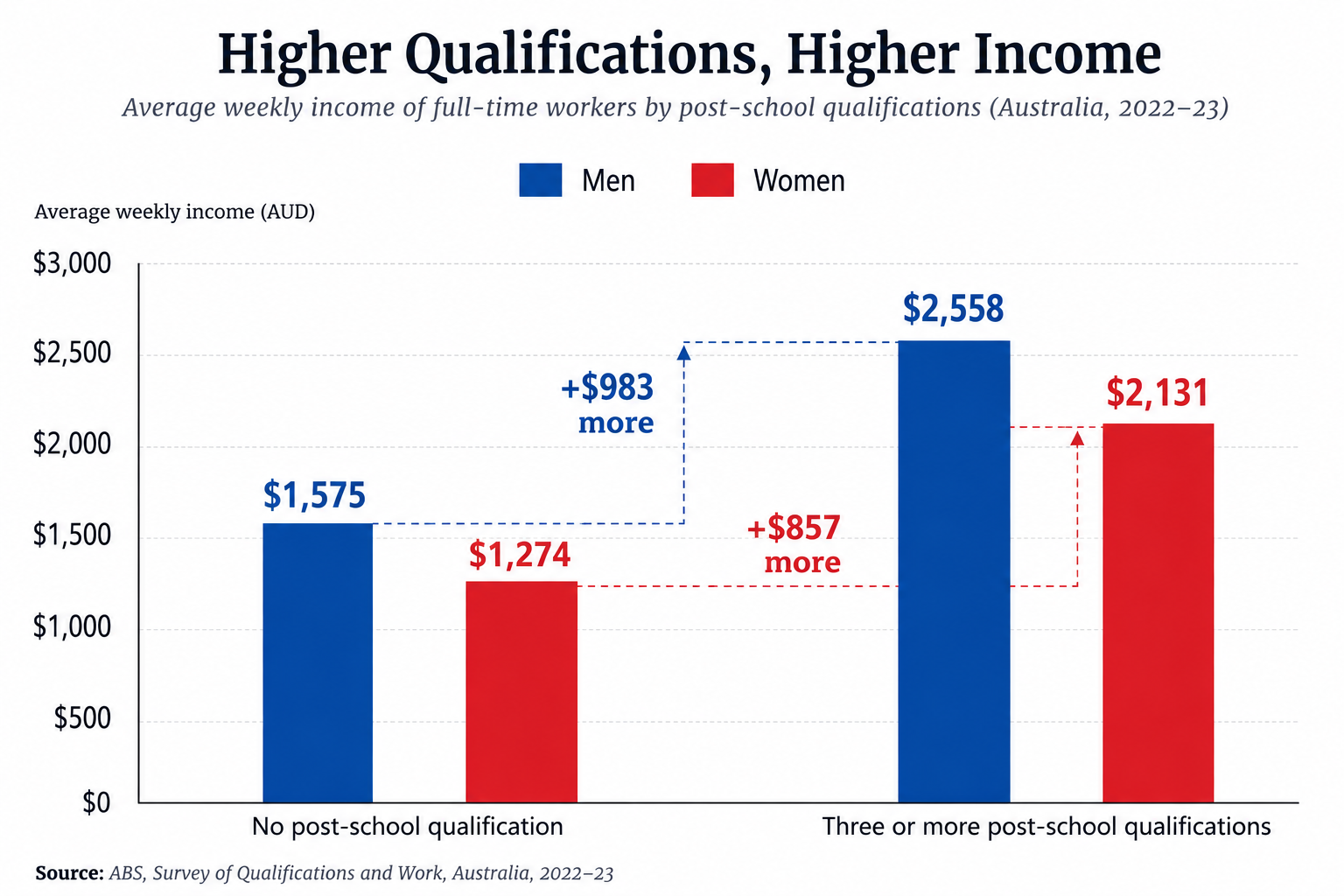
The ABS data doesn’t distinguish between fields, though — it shows qualifications matter, not that all qualifications deliver the same return. That’s where Grattan’s field-specific modelling adds the missing layer: asking whether university pays off is only half the question. Which degree is just as important.
The Layer Nobody Priced Into Any of This
Everything above is historical — it tells us what happened to past graduates in past labour markets. Students enrolling today will graduate into a different one.
Jobs and Skills Australia’s research on occupational exposure to generative AI is the most rigorous local work on this, and its conclusion is more measured than the headlines suggest: AI currently looks more likely to assist workers and automate specific tasks than replace people outright. The international picture is less settled. Tufts University’s research flagged writers, computer programmers, and web/digital designers among the most exposed occupations, and Microsoft Research found similar overlap after analysing hundreds of thousands of real Copilot interactions — concentrated in writing, editing, translation, and market research roles.
The pattern worth noticing: many of the occupations ranking highest for AI exposure are exactly the ones a university degree has traditionally prepared people for, while nursing, skilled trades, and hands-on healthcare support rank consistently lower. That doesn’t mean university is becoming obsolete or that these professions will disappear — but it does mean a student choosing a degree today is taking on a risk earlier generations rarely had to price in: not just what a career pays now, but how much it might change over the next decade.
Where This Collides with the Debt Numbers
This is where it stops being an abstract labour-market question and becomes a financial reality — and the scale of the debt makes it concrete.
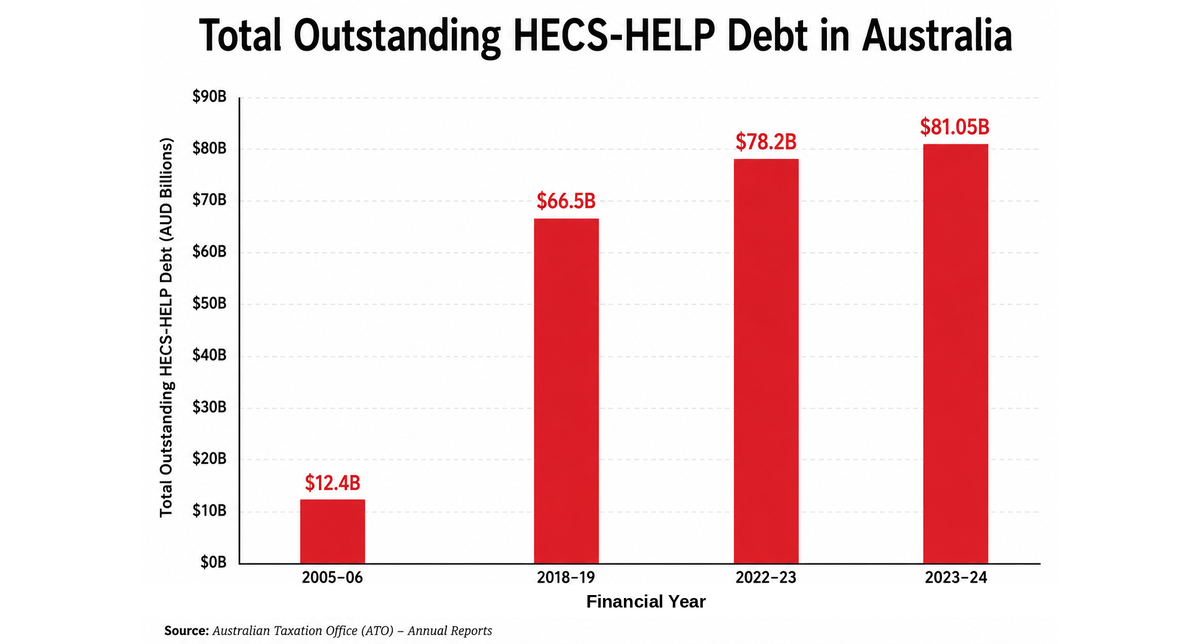
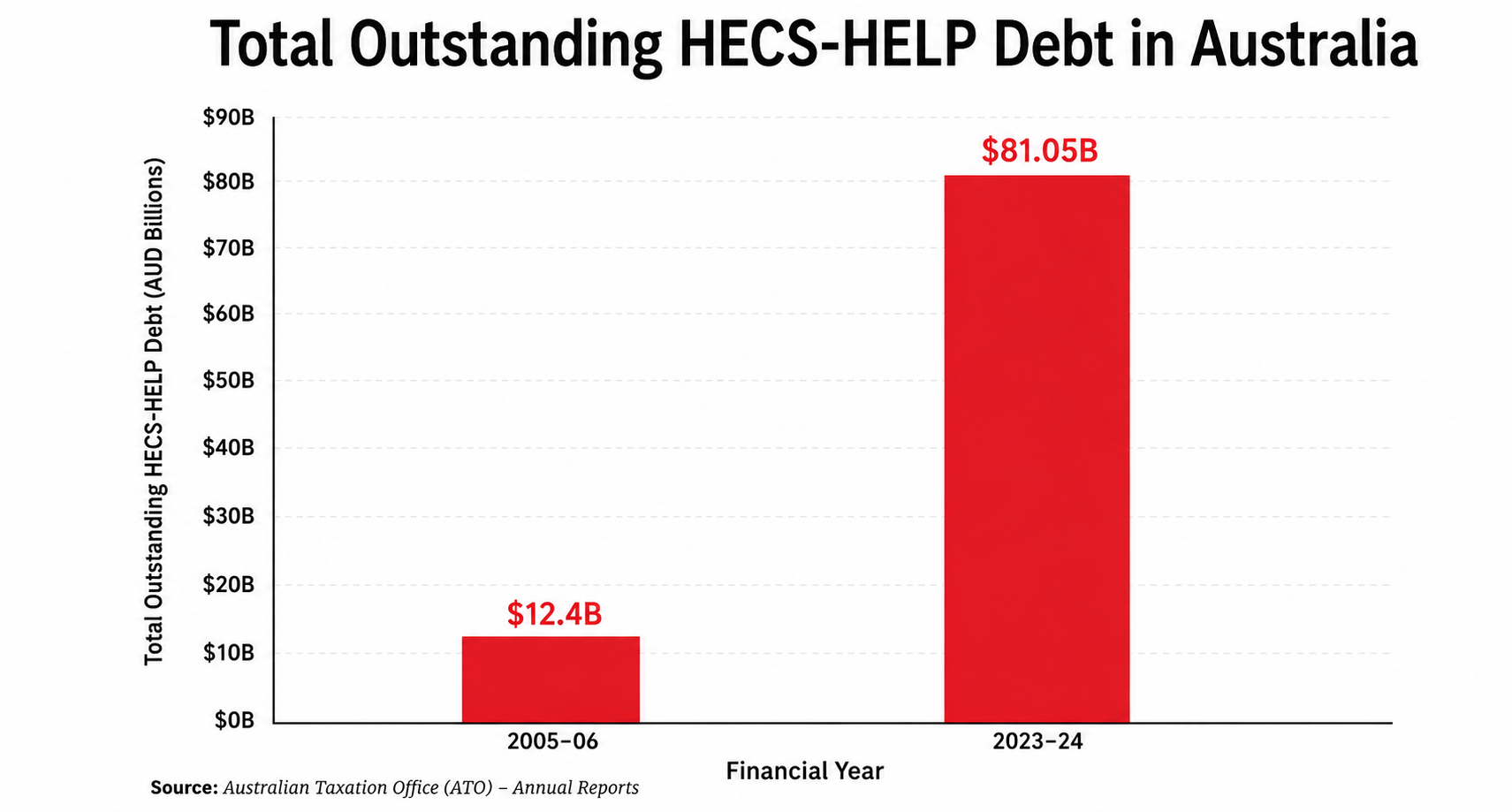
Total outstanding HECS-HELP debt sits at $81.05 billion, held by roughly 2.93 million Australians — up from $78.2 billion the year before. One in four debtors now owes more than $40,000, and debt sizes have outpaced inflation: Australians in their 20s carry debts around 45% higher in real terms than their equivalents did twenty years ago.
It also takes longer to clear than it used to. The average HECS-HELP debt now takes 9.5 to 9.9 years to fully repay — up from about 7.5 years fifteen years ago. In practice, for someone repaying steadily, that means a payoff window running from the mid-20s through to the mid-to-late 30s. And the tail extends further than most people assume: ATO data has found tens of thousands of Australians still carrying HECS-HELP debt at age 60 and beyond.
Grattan’s Risks and Rewards modelling separately estimated that around 30% of male graduates — higher in some fields — are unlikely to ever fully repay their HELP debt, based purely on historical earnings, with no AI factored in. Stack a decade-long repayment window, and a real tail still outstanding at 60, against a labour market that’s shifting under the exact professions many degrees lead to, and “will this occupation still look similar in ten years” stops being a hypothetical question and becomes a legitimate part of the decision.
What This Means
None of this is an argument against university — many professions will keep offering strong long-term outcomes, and AI is likely to enhance plenty of jobs rather than replace them. What’s changed is how a degree should be evaluated. For years, the only question that mattered was “how much does this profession pay?” A second question now deserves equal weight: “how likely is this profession to look different a decade from now?”
No one can answer that with certainty. But when the debt behind the decision takes the better part of a decade to repay — and sometimes decades longer — asking both questions before enrolling is simply due diligence, not pessimism.
Subscribe to my Newsletter for more data-led breakdowns like this one — no hype, just what the numbers actually say.
Natalie Goretski is the founder of iViser Academy, an online financial education platform helping high-income professionals build structured, AI-powered financial systems.
Disclaimer: The information provided in this article, “9.9 Years to Repay a Degree That Might Not Exist By Then”, is intended for educational and informational purposes only. It does not constitute financial advice, legal advice, or professional recommendations.
While every effort has been made to ensure the accuracy of the information at the time of publication, iViser Academy and the author make no guarantees of completeness, reliability, or applicability to your individual circumstances.
You should always consider your personal financial situation and, where necessary, seek independent advice from a licensed financial professional before making financial decisions. The author and iViser Academy accept no liability for any loss, damage, or consequences that may arise from reliance on the content of this guide. Use of this material implies acceptance of this disclaimer.